
The world we live in today has heavy information overload. We weren't evolutionarily meant to spend so much time indoors, staring at screens, managing the endless stream of thoughts: what we have to do today, what happened yesterday, an opinion on an article just read, a tweet, a status update — the list really does go on and on.
A vehicle driven continually with no maintenance breaks down faster; our brains work similarly, not meant for never-ending thought. Even when we sleep, we are still thinking.
Meditation on the heart
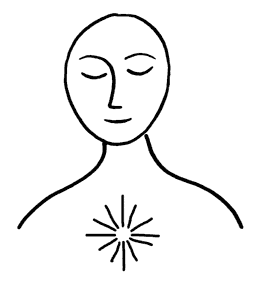
When we apply consciousness to learn about ourselves, it is as if thoughts and feelings become separate. Meditating on the heart makes us feel one with nature, develops intuitive understanding, and heals and transforms us.
Why meditate
Regular practice improves quality of life, relieves stress, improves sleep, stimulates the immune system, and sharpens concentration. Meditation is either going thoughtless, or focusing on a single idea while still aware of your surroundings.
Four states of human awareness
- Jagruti — the waking state of consciousness
- Swapna — the dreaming state of consciousness
- Sushupti — the state of deep sleep in which mind, ego and superego are still
- Turya — the state of thoughtless awareness beyond the mind
A thoughtless mind can be incredibly powerful — stop thinking about a problem, and the solution often appears hours later; a thoughtless mind enables some of the most creative things we will ever do. Thoughtless awareness, as per yoga, is considered the highest stage of meditation: Achintaiva Parama Dhyana, as Adi Guru Shankaracharya put it.
Buddha was asked what he gained from meditation. “Nothing,” he replied. Asked what he lost: “Anger, Anxiety, Depression, Insecurity, Fear of Old Age and Death.”