
Guru Nanak Dev Ji Udasis
What were the Udasis?
Guru Nanak Dev Ji, the founder of Sikhism, was also one of the great travellers of history. For about 24 years he journeyed on foot and by sea — from Punjab to Assam and Odisha, south to Sri Lanka, north into the Himalayas and west to Mecca and Baghdad — to awaken people to the oneness of creation. His companion on these journeys was Bhai Mardana, who played the rabab as the Guru sang his bani.
These spiritual journeys are known as the Udasis. The word comes from udas, meaning detachment: the journeys were meant not to cross borders but to reach people’s hearts.
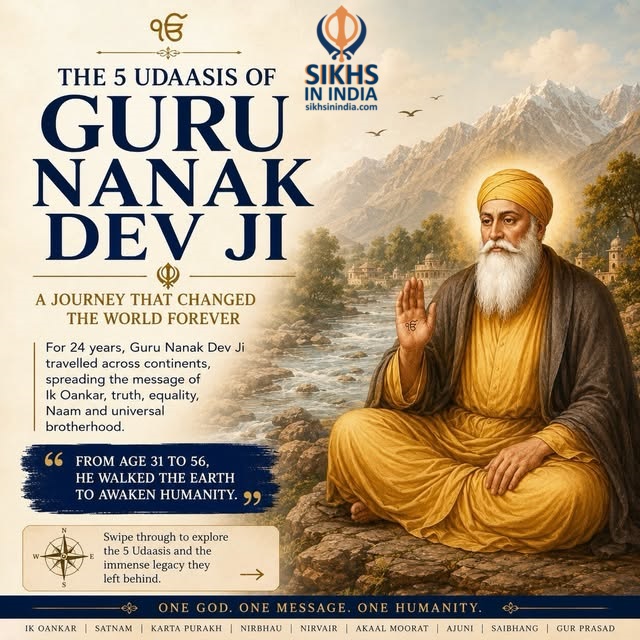
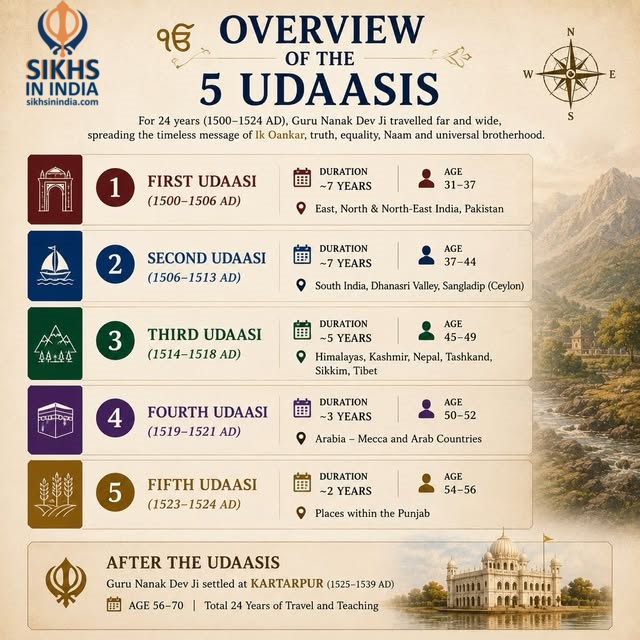
Four major Udasis are commonly counted — to the east, south, north and west. Some Janam Sakhi traditions, such as the Puratan Janam Sakhi, also record a fifth, shorter journey within Punjab. This page follows the five-journey account. The dates are approximate and differ between sources.
First Udasi: East, North and North-East India (c. 1500–1506)
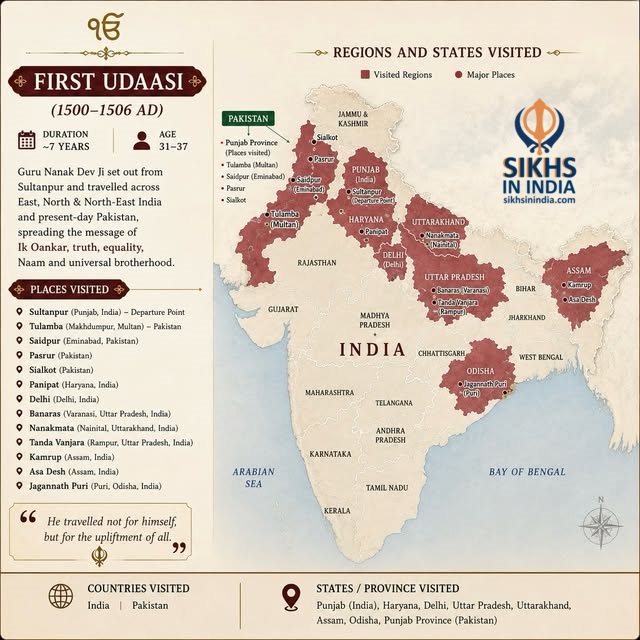
Setting out from Sultanpur Lodhi, Guru Nanak Dev Ji travelled through Tulamba, Saidpur (Eminabad), Pasrur and Sialkot in present-day Pakistan, and then east through Panipat, Delhi and Banaras to Nanakmata, Tanda Vanjara, Kamrup and Asa Desh in Assam, and Jagannath Puri in Odisha. This was the longest of the journeys.
Among its best-known episodes is the Guru’s visit to Haridwar. Seeing pilgrims throwing water towards the rising sun for their ancestors, he began throwing water to the west, towards his fields in Punjab: if their water could reach the dead, why could his not reach fields far less distant? It was a lesson that ritual without understanding is empty. In Kamrup he met followers of the Tantric and Shakti traditions, teaching that the Divine is reached through love and devotion, not through rituals of fear.
Second Udasi: South India and Sri Lanka (c. 1506–1513)
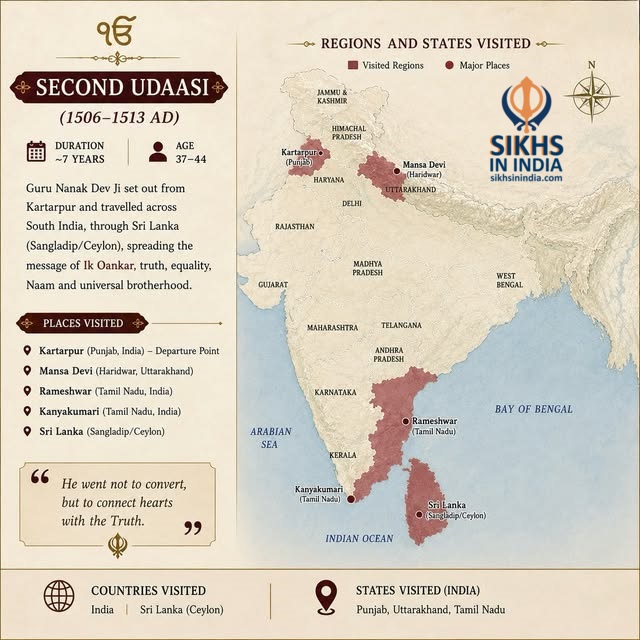
On his second journey the Guru travelled the length of India to the south, by way of Haridwar (Mansa Devi), to Rameshwaram and Kanyakumari in Tamil Nadu, and across the sea to Sri Lanka, called Sangladeep in the Janam Sakhis. Everywhere he met people of every faith and walk of life, and shared the same message of Ik Oankar, truth and equality.
Third Udasi: The Himalayas and Beyond (c. 1514–1518)
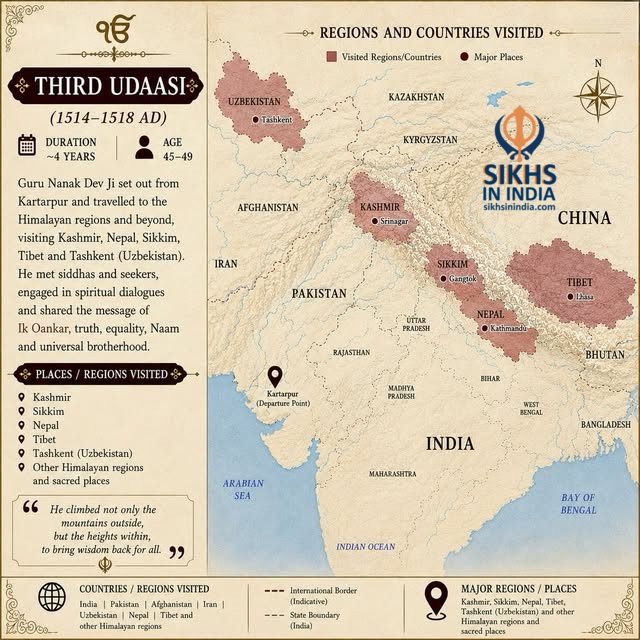
The third Udasi took Guru Nanak Dev Ji north into the Himalayas — through Kashmir, Nepal, Sikkim and Tibet, and on to Tashkent in present-day Uzbekistan. He engaged with Nath yogis (the Siddhas) and Buddhist monks, questioning asceticism and withdrawal from society as paths to God.
The Janam Sakhis place his dialogue with the Siddhas on Mount Sumer during this journey. The Guru’s teaching — that true renunciation is of the ego, not of family and social responsibility — is set out in the bani Sidh Gosht in Sri Guru Granth Sahib Ji.
Fourth Udasi: Arabia, Mecca and Baghdad (c. 1519–1521)
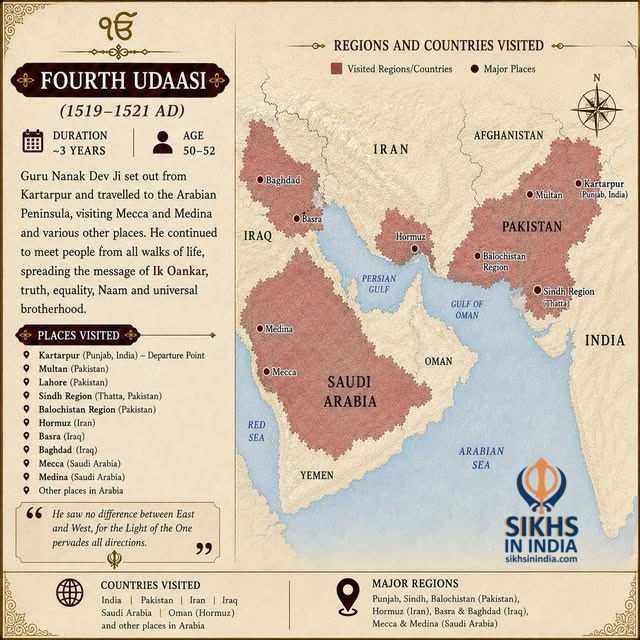
The fourth Udasi was the most far-reaching. The Guru travelled west through Multan, Lahore, Sindh and Balochistan to Hormuz, and on to Mecca and Medina, and then to Basra and Baghdad. The Janam Sakhis describe him wearing a robe that combined Hindu and Muslim dress, accompanied by Bhai Mardana, a Muslim musician.
At Mecca, the Janam Sakhis relate, he was found resting with his feet towards the Kaaba. When rebuked, he asked to be turned towards a direction where God was not — and the Kaaba is said to have appeared wherever his feet were turned. The lesson is that God is present everywhere, not confined to any one direction. In Baghdad, a memorial commemorating his visit is said to have stood for centuries.
Fifth Udasi: Within Punjab (c. 1523–1524)
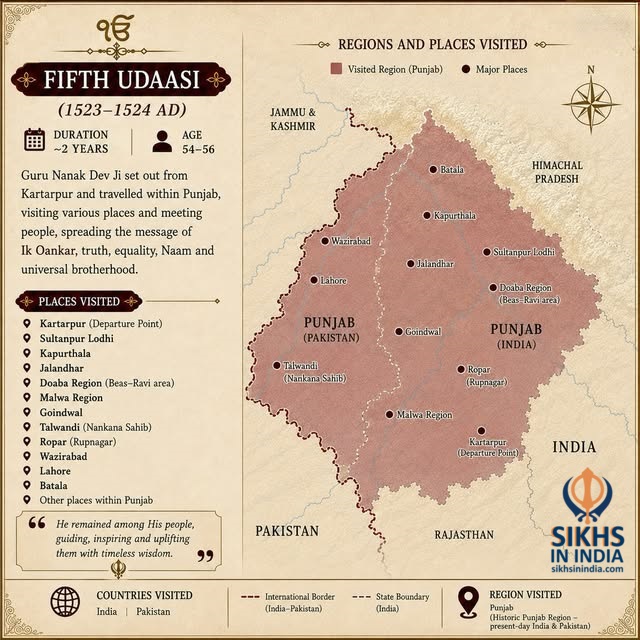
The fifth journey was shorter and stayed within Punjab. From Kartarpur the Guru visited Sultanpur Lodhi, Kapurthala, Jalandhar, the Doaba and Malwa regions, Goindwal, Talwandi (Nankana Sahib), Ropar, Wazirabad, Lahore and Batala, meeting people and spreading the same message of Ik Oankar, truth, equality and Naam.
After the Udasis: Kartarpur (1525–1539)

After his travels, Guru Nanak Dev Ji settled at Kartarpur on the banks of the Ravi and lived there until 1539. He farmed the land and built a community around the practices of sangat (congregation) and langar (the community kitchen), teaching the path of Naam japna (remembering God’s name), kirat karni (honest living) and vand chhakna (sharing with others) that became the foundation of Sikh life. Kartarpur Sahib is now in Pakistan and can be visited from India through the Kartarpur Corridor.
Frequently Asked Questions
What are the Udasis of Guru Nanak Dev Ji?
The Udasis are the spiritual journeys Guru Nanak Dev Ji made between about 1500 and 1524 across South Asia, the Himalayas and the Middle East, to share the message of Ik Oankar — the oneness of God — with scholars, saints and ordinary people of all faiths.
How many Udasis did Guru Nanak Dev Ji undertake?
Four major Udasis are commonly counted: to the east, south, north and west. Some Janam Sakhi traditions also record a fifth, shorter journey within Punjab, which is why the Udasis are often described as five.
Did Guru Nanak Dev Ji visit Mecca?
Yes. The Janam Sakhis record that he visited Mecca and Medina during the westward Udasi, and relate the well-known episode of his feet and the Kaaba, which teaches that God is present in every direction.
How long did the Udasis take?
Taken together, the journeys spanned about 24 years, from around 1500 to 1524, after which Guru Nanak Dev Ji settled at Kartarpur.
What was the purpose of the Udasis?
They were not pilgrimages in the usual sense. Guru Nanak Dev Ji used them to speak with priests, scholars, yogis and rulers, challenging empty ritual, caste discrimination and superstition, and sharing the path of Naam japna, kirat karni and vand chhakna.
Where did Guru Nanak Dev Ji settle after the Udasis?
At Kartarpur on the Ravi, in present-day Pakistan, where he lived until 1539. It can be visited from India through the Kartarpur Corridor.